Last year I contributed to an assessment on building capacity in Curaçao’s agricultural sector: farming, livestock and fisheries. Here is what I took away from it.
What is food security?
According to the Food and Agriculture Organization of the United Nations, food security exists when all people, at all times, have physical and economic access to sufficient, safe and nutritious food that meets their needs and preferences. It rests on four pillars:
- Availability: is there food?
- Access: can people afford it and reach it?
- Utilization: is it healthy and nutritious, and do people know how to use it?
- Stability: does that hold up during shocks, such as a pandemic, a closed border or a hurricane?
The debate almost always focuses on the first pillar alone: availability, and scaling up production. On Curaçao, all four are in play.
The context in numbers
Curaçao covers 444 km². The Island Development Plan officially zones only 6% of that for agriculture, roughly 2,600 hectares. Several thousand buildings stand on that agricultural land, and much of it is farmed only part-time or not at all. Meanwhile, 150,000 residents and more than a million tourists a year need to eat. Over 95% of our food is imported.
The island’s carrying capacity is limited. Full self-sufficiency isn’t realistic, and it doesn’t need to be the goal. But there is clear room for improvement, both in the quantity and the quality of what we produce ourselves.
So who is the farmer on Curaçao? Much of the sector is self-taught. Farming is often reactive. Official paperwork and business management skills are frequently missing, and many farmers need side jobs to make ends meet. This isn’t a lack of commitment. The system around them simply doesn’t support them enough.
The bottlenecks
The bottlenecks are intertwined. I group them into five clusters.
- Natural conditions. We have a semi-arid climate that is becoming more erratic with climate change. Water is scarce and expensive, the soil is poor in nutrients, and little agricultural land is available.
- People and knowledge. There aren’t enough hands, and too few young people are taking over from the old guard. Knowledge is lacking, both about growing and about running a business.
- Resources. Tools and heavy machinery are hard to access. Financing is often out of reach for small farmers.
- The supply chain. Storage, distribution and sales are poorly organized. Prices don’t reflect real costs, and local produce has to compete with cheap imports.
- Governance and trust. Food security touches all nine ministries: land and water (VVRP), sector policy (MEO), taxes and import exemptions (Finance), food safety (GMN), education (OWCS), labor (SOAW), permits (BPD) and crisis management (AZ). That fragmentation makes coordination difficult. Trust and cooperation are lacking, among farmers and between farmers and government.
This is a key point: investing in production alone runs into a wall in the supply chain. A farmer who harvests more but can’t store it or sell it at a fair price ends up worse off.
Where are the gains?
- Education and guidance, both in the field and in business management, together with local knowledge and knowledge institutions.
- Access to financing and equipment, for example through shared machinery pools, cooperatives and forms of financing suited to small-scale farmers.
- Strengthening the supply chain: shared storage, purchase guarantees, local sourcing by hospitality and tourism, and schools and healthcare as steady buyers.
- Policy that doesn’t disadvantage local produce, with regulations that are workable and enforceable.
Concrete steps per pillar
If we look beyond production alone, there are concrete steps to take for each pillar.
- Availability. More food can become available even without extra production: by spreading imports across more trading partners and routes, by reducing waste, and by processing locally so harvests keep longer and yield more. We can also create value from invasive species: eat them to beat them.
- Access. Pricing policy on healthy staple foods, school meals, and better physical access to fresh produce in neighborhoods.
- Utilization. Nutrition education and cooking skills, a renewed appreciation of traditional food, and stricter enforcement of food safety.
- Stability. Strategic reserves and emergency plans, reuse of water and residual streams, rainwater harvesting, regenerative agriculture, and better communication and cooperation between government and farmers.
A fifth pillar: community
I’d like to add a fifth pillar of solutions: the community. A sustainable community thinks about the future.
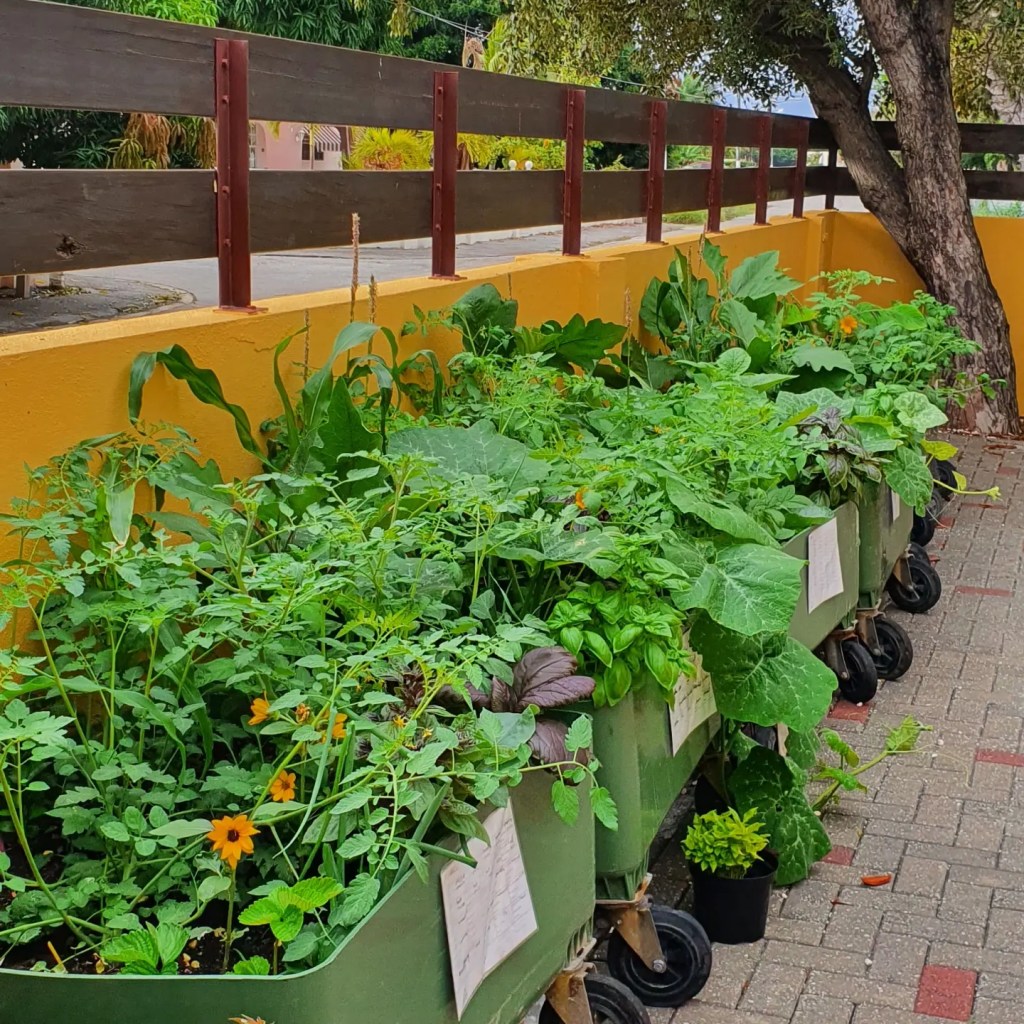
- Home gardens, school gardens and neighborhood gardens don’t deliver large volumes, but they do build resilience, knowledge and engagement.
- Compost from organic waste closes loops and makes us less dependent on imported fertilizers.
One shared food strategy
Food security on Curaçao is not just an agricultural issue. It’s about land and water, health and education, prices and income, being prepared for the next crisis, and a community that once again knows what it eats and where it comes from.
The solutions already exist, in pieces, scattered across ministries, organizations and people. What’s missing is coordination and cooperation: one shared food strategy in which government, farmers, education, tourism and the community all pull in the same direction.

