
Sun-drenched beaches, turquoise waters, vibrant nightlife — Curaçao is often portrayed as a Caribbean success story. Tourism is booming, airport records are broken year after year, cruise ships line the harbor, and politicians proudly announce rising revenues. On paper, it looks like paradise is thriving.
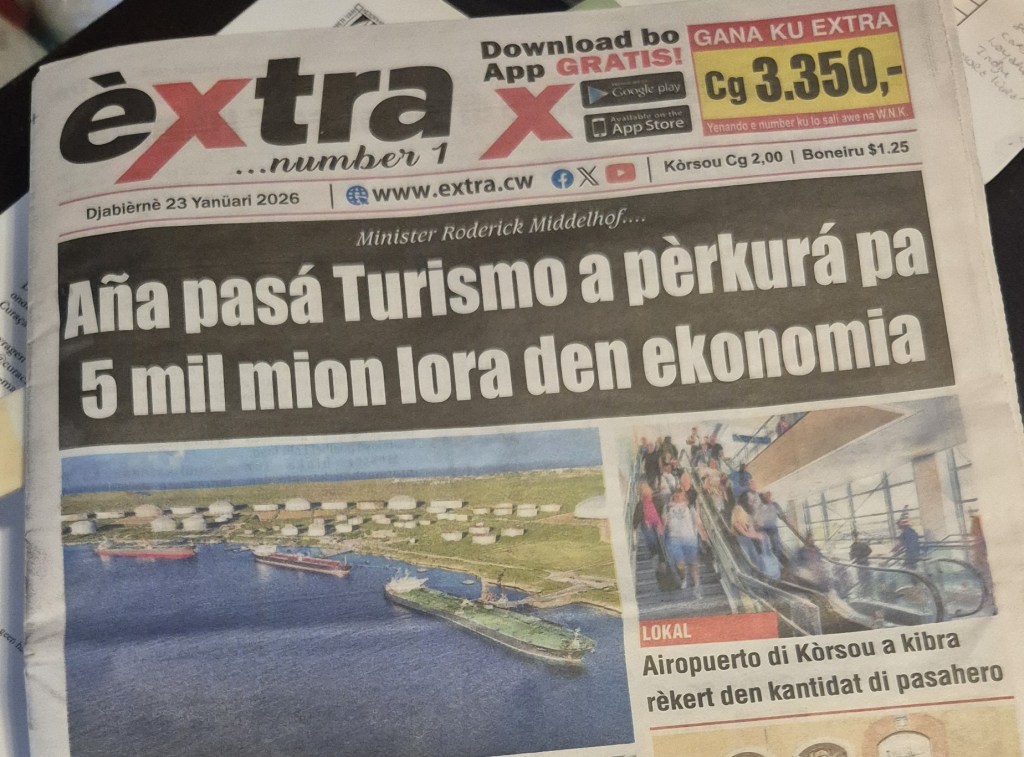
But beneath this glossy image lies a more complicated reality.
Tourism has become the economic backbone of Curaçao, contributing nearly half of the island’s GDP. Yet the same industry that fuels economic growth is also placing increasing pressure on the island’s fragile environment, infrastructure, and communities. While coral reefs often dominate discussions about environmental damage, the true footprint of tourism extends far beyond what lies beneath the waves.
This raises an uncomfortable question: how much tourism can a small island really sustain?
When Growth Is the Only Success Story
Public discourse around tourism in Curaçao is largely framed in economic terms. Success is measured through visitor numbers, hotel occupancy rates, cruise arrivals, and revenue statistics. These figures are easy to quantify, easy to celebrate, and politically attractive — especially in a small island economy with limited alternatives.
Environmental concerns, by contrast, are often treated as secondary issues or future problems. Climate change, ecosystem degradation, and infrastructure overload are acknowledged, but rarely allowed to shape decisions about tourism growth itself. The assumption seems to be that environmental impacts can be managed later, with better technology, more data, or targeted mitigation measures.
This framing matters. What gets defined as “the problem” also defines what counts as a legitimate solution.
Beyond Coral Reefs: The Broader Environmental Toll of Tourism
Coral reefs are undeniably vital — they support biodiversity, protect coastlines, and underpin marine tourism. But focusing on reefs alone obscures the wider environmental consequences of mass tourism on a small, semi-arid island like Curaçao.
Water Scarcity
Tourism dramatically increases water demand in a place where freshwater is already scarce. Hotels, resorts, golf courses, cruise ships, and short-term rentals consume far more water per capita than local households. Desalination makes this possible, but at a high energy and financial cost, further entangling tourism with fossil fuel dependence.
Energy Use and Emissions
Air travel, cruise shipping, air conditioning, desalination plants, and constant construction all require massive amounts of energy. As tourism grows, so does Curaçao’s carbon footprint — even as climate change increases temperatures, sea-level rise, and extreme weather risks.
Waste and Sewage
Tourists generate significantly more waste than residents. Curaçao’s landfill is nearing capacity, sewage treatment infrastructure is insufficient, and untreated wastewater and solid waste still end up in the ocean. Cruise ships add to the problem by offloading waste while docked, shifting environmental burdens onto the island.
Coastal and Land Use Pressure
Tourism development is concentrated along the coast, leading to the removal of mangroves, artificial beach creation, habitat loss, and shoreline modification. These changes weaken natural coastal defenses and increase vulnerability to storms and erosion — precisely when climate risks are intensifying.
Social and Community Impacts
Environmental pressure is inseparable from social pressure. Rising real estate prices, coastal privatization, informal short-term rentals, and unequal access to resources disproportionately affect local communities. The people benefiting most from tourism growth are often least exposed to its environmental consequences.
Why Knowledge Isn’t Enough
Scientific studies, monitoring reports, and climate assessments exist. Researchers have documented reef decline, water quality issues, waste bottlenecks, and climate vulnerability for years. So why does policy remain largely unchanged?
The problem isn’t a lack of knowledge — it’s how knowledge is used, framed, and valued.
Environmental knowledge is often:
- Long-term rather than immediate
- Uncertain rather than precise
- Complex rather than easily translated into policy targets
Economic knowledge, on the other hand, aligns neatly with short political cycles and institutional goals. Visitor numbers go up; success is declared.
Uncertainty plays a crucial role here. Environmental uncertainty is frequently used as a reason to delay action rather than apply precaution. Climate risks are framed as manageable or distant, while economic risks are perceived as urgent and tangible.
Fragmented Governance, Fragmented Solutions
Tourism governance in Curaçao is spread across multiple ministries and agencies, each with its own mandate, priorities, and data systems. Economic development, spatial planning, environmental protection, labor policy, and infrastructure are rarely integrated into a single long-term vision.
As a result:
- Environmental impact assessments remain project-based
- Long-term carrying capacity is rarely addressed
- Policies are reactive rather than strategic
- Data is fragmented and inconsistently shared
Community participation is minimal, often limited to late-stage consultations where key decisions have already been made. Local and experiential knowledge — from fishers, dive operators, residents, and environmental volunteers — is rarely treated as legitimate expertise.
Rethinking Tourism as a Social and Environmental Choice
The core issue facing Curaçao is not whether tourism is good or bad. It is how tourism is framed.
As long as growth is treated as an unquestioned goal, environmental limits will always appear as obstacles rather than signals. Climate change, biodiversity loss, water scarcity, and waste overload are not externalities — they are symptoms of a development model pushing beyond ecological and social boundaries.
For small island states especially, sustainable tourism cannot be reduced to marketing slogans or isolated conservation projects. It requires:
- Integrating environmental, economic, and social knowledge
- Applying precaution under uncertainty
- Valuing local and experiential expertise
- Shifting from short-term gains to long-term resilience
Paradise, after all, is not just something to sell. It is something to protect — for those who live there now, and for those who will inherit the island in the future.
 yuditera.com